

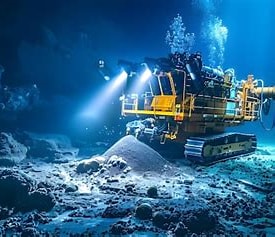
The deep-sea floor, miles beneath the surface, holds vast reserves of polymetallic nodules—potato-shaped rocks rich in critical minerals. These are the same minerals essential for the "green revolution" and the electronic devices we rely on every day.
While the previous blog focused on the ecological risks to our seafood supply, this piece focuses on the economic drivers of deep-sea mining. Understanding which minerals are targeted and where they end up is key to grasping the scale and urgency of this emerging industry.
The Treasure Trove: Key Minerals in Polymetallic Nodules
The polymetallic nodules targeted in areas like the Clarion-Clipperton Zone (CCZ) are not just ordinary rocks; they are mineral cocktails formed over millions of years. The four most commercially valuable minerals found in these nodules are:
1. Nickel (Ni)
* Role in Technology: Nickel is a core component in the cathode of lithium-ion batteries, particularly the high-energy-density Nickel Manganese Cobalt (NMC) and Nickel Cobalt Aluminium (NCA) chemistries used in electric vehicles (EVs) and high-end electronics. It allows batteries to store more power and charge faster.
* Consumer Products: Electric car batteries, laptops, mobile phones, and stainless-steel products (like kitchen appliances and surgical tools).
2. Cobalt (Co)
* Role in Technology: Cobalt is critical for stabilizing the performance and increasing the lifespan of lithium-ion batteries. It prevents the battery from overheating and degrading too quickly. The demand for cobalt is soaring due to the rapid growth of the EV market.
* Consumer Products: Virtually all rechargeable batteries (phones, tablets, power tools, EVs), pigments (for bright blue colours), and specialized superalloys used in jet engines.
3. Copper (Cu)
* Role in Technology: Copper is an unparalleled electrical and thermal conductor. It is essential for wiring, motors, and electrical infrastructure in almost all electronic devices and clean energy technologies.
* Consumer Products: Electrical wiring (homes, cars), printed circuit boards (PCBs) in every electronic device, computers, and electric motors.
4. Manganese (Mn)
* Role in Technology: Manganese makes up the bulk of the nodules (up to 30% by weight). In batteries, it helps improve safety, thermal stability, and low cost (e.g., in Lithium Manganese Oxide batteries). It is also vital for high-strength steel alloys.
* Consumer Products: High-strength steel (for construction and vehicles), common alkaline batteries, and certain pigments and chemical processes.
The Energy Transition Equation
The primary argument fuelling the push for deep-sea mining is the immense global demand for these minerals to facilitate the transition away from fossil fuels.
The shift to renewable energy requires vast amounts of metals:
* Electric Vehicles (EVs): An EV requires significantly more copper and nickel than a traditional combustion engine car. The International Energy Agency (IEA) projects that mineral demand for clean energy technologies could double by 2040.
* Grid Infrastructure: Solar panels, wind turbines, and the massive battery storage systems needed to stabilize electrical grids all require these critical minerals.
Currently, these minerals are primarily sourced from terrestrial mining—operations that often involve significant social and environmental costs, including habitat destruction and land use conflicts. Proponents of deep-sea mining argue that extracting these minerals from the deep ocean floor could offer a more secure and diverse supply and potentially mitigate some of the negative impacts associated with land-based operations.
The Critical Choice: Ocean Health vs. Mineral Demand
This presents seafood consumers, and global society, with a genuine dilemma. We need these critical minerals to combat climate change, but the UH Mānoa study we discussed previously confirms that extracting them could seriously damage the ocean's food web.
The choice is between securing materials for a greener future and protecting the foundational ecosystem that supports global fisheries. The potential consequences—from starved zooplankton to disrupted tuna stocks—are directly related to the health of the minerals' source: the twilight zone.
The Circular Solution: Many scientists and NGOs argue that the immediate focus must be on reducing the need for new primary materials. This means prioritizing:
Recycling: Creating robust, large-scale, and efficient mineral recycling programs for e-waste and EV batteries.
Sustainable Design: Developing battery technologies that use less of the most environmentally sensitive minerals (e.g., shifting to sodium-ion or cobalt-free chemistries).
Reduced Consumption: Making our electronic devices last longer and focusing on responsible consumption patterns.
The deep sea holds the raw materials for our high-tech, low-carbon future. But if harvesting them destroys the basic engine of the ocean food chain, the long-term cost to our planet and our seafood security may be catastrophic. Every decision we make about sustainable technology and resource management has an echo in the deep, silent parts of the sea.
Comments
No comments yet.