

Who Governs the Deep?
The deep sea, home to the mineral wealth needed for our energy transition, is largely outside the jurisdiction of any single country. This immense territory—covering about 50% of the Earth's oceans—is governed by a complex international treaty structure and a single regulatory body.
As consumers, understanding this governance and the timeline for mining is crucial, as it determines how fast the environmental risks to our seafood supply could materialize.
The Watchdog: The International Seabed Authority (ISA)
The global body responsible for regulating mineral-related activities in the international seabed area, known as "The Area," is the International Seabed Authority (ISA).
* Mandate: Established under the 1982 UN Convention on the Law of the Sea (UNCLOS), the ISA's mission is two-fold:
* To authorize and control the development of mineral operations in The Area, which is considered the "common heritage of all mankind."
* To ensure the effective protection of the marine environment from harmful effects arising from mining activities.
* Status: The ISA is an intergovernmental organization based in Kingston, Jamaica, with 168 member states (167 countries plus the European Union).
* The Mining Code: The ISA is currently negotiating a comprehensive set of rules, regulations, and procedures—known as the Mining Code—that would govern the commercial exploitation (mining) phase.
The Ticking Clock: The Timeline for Commercial Mining
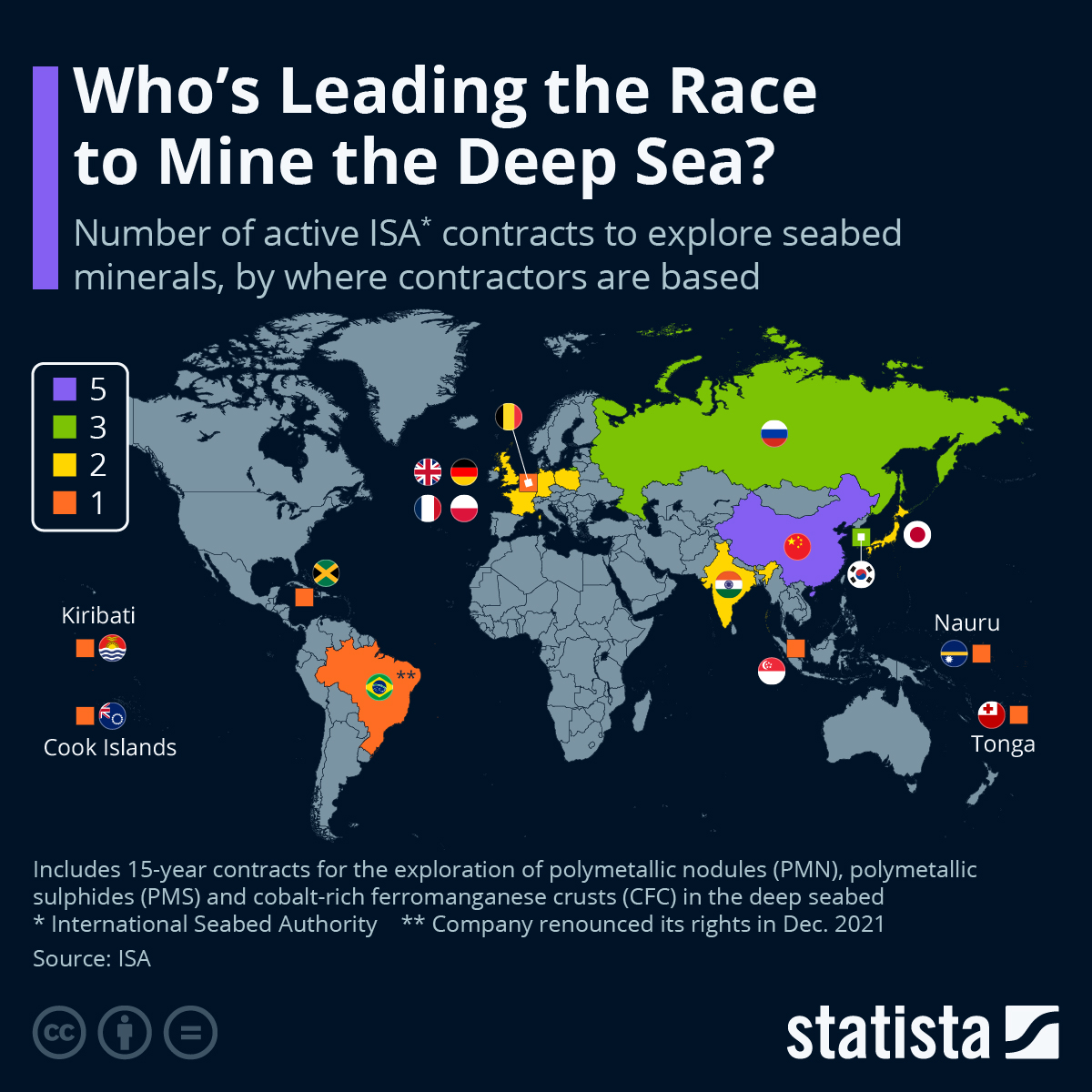
The ISA has already issued over 30 exploration contracts (covering about 1.5 million square kilometres) for three types of deep-sea deposits, but it has not yet approved any contracts for commercial exploitation. However, a critical event has accelerated the timeline:
The "Two-Year Rule"
* In June 2021, the Pacific island nation of Nauru, which sponsors a deep-sea mining company, invoked a treaty provision known as the "two-year rule."
* This rule obligated the ISA to finalize the Mining Code by July 2023.
* The Critical Implication: If the ISA fails to adopt the regulations within that timeframe—which they did—and an exploitation application is submitted, the ISA must still consider and provisionally approve the application.
The Current Standoff
The timeline is now uncertain and politically charged:
* The ISA Council did not finalize the Mining Code by the July 2023 deadline.
* Industry proponents, such as The Metals Company (TMC), have signalled their intention to submit a formal application for commercial extraction in the coming years (as early as June 2025, according to earlier company statements).
* A growing number of countries, including Chile, France, Germany, and the UK, are now calling for a moratorium or a precautionary pause on deep-sea mining until adequate science and robust, comprehensive environmental safeguards are fully in place.
* The ISA Council has reaffirmed its July 2023 decision that no mining should commence in the absence of a mining code, though the legal implications of the two-year rule remain a significant point of conflict.
In short, while there is currently no commercial mining occurring, the legal window for applications to be considered—even without a complete regulatory framework—has opened, creating an urgent situation for environmental protection.
Where Will Mining Take Place? The Global Hotspots
While exploration contracts exist across the Atlantic, Pacific, and Indian Oceans, the overwhelming focus for commercial mining, and the area discussed in the University of Hawaiʻi study, is the Clarion-Clipperton Zone (CCZ).
1. The Clarion-Clipperton Zone (CCZ)
* Location: The CCZ is a massive abyssal plain, approximately 4.5 million square kilometres (about half the size of the continental United States), stretching across the central Pacific Ocean between Hawaiʻi and Mexico.
* Target Deposit: This area is rich in polymetallic nodules—the potato-sized rocks containing nickel, copper, cobalt, and manganese.
* Exploration Status: The CCZ is the global epicentre of interest, with the ISA already having granted numerous exploration contracts covering roughly 1 million square kilometres of this region. This is the zone where the sediment plume effects on the twilight zone food web (as highlighted by the UH study) are most immediately threatened.
2. Other Key Exploration Areas
While the CCZ is the main target for nodules, the ISA has also granted exploration contracts for other types of deep-sea mineral deposits:
* Mid-Atlantic Ridge: Targeted for Polymetallic Sulphides (deposits around hydrothermal vents rich in copper, zinc, gold, and silver).
* Central Indian Ocean Basin & Pacific Seamounts (e.g., near Japan and Micronesia): Targeted for Cobalt-rich Ferromanganese Crusts (deposits on underwater mountains or seamounts).
The critical point is that the international seabed, considered the common heritage of mankind, is now mapped out for potential industrial exploitation. The immediate fate of the CCZ, a vital area for the Pacific's tuna and other large migratory fish—the very source of our seafood—is now being decided in the halls of the ISA.
Would you like to know which specific countries or entities currently hold the largest exploration contracts in the Clarion-Clipperton Zone?
The Heavy Hitters: Entities with the Largest Claims in the Clarion-Clipperton Zone (CCZ)
The exploration of the Clarion-Clipperton Zone (CCZ) is a complex geopolitical effort involving governments, state-owned enterprises, and private companies. In the international seabed, all exploration contracts are issued by the International Seabed Authority (ISA) and must be sponsored by a Member State.
The major entities holding the largest number of contracts or controlling the most significant areas for polymetallic nodule exploration in the CCZ fall into two main categories: Asia/Pacific Governments & State Entities and Commercial Consortia Sponsoring Pacific Island Nations.
1. China: The Leading State Player
China is currently the country with the highest number of overall deep-sea mining exploration contracts globally and a significant number of these are focused on the CCZ. China utilizes multiple state-affiliated entities to secure these contracts, effectively expanding its resource base and influence.
* Key Contractors:
* China Ocean Mineral Resources Research and Development Association (COMRA)
* China Minerals Corporation
* Beijing Pioneer Hi-Tech Development Corporation
* Significance: China's strategy involves heavy state backing, research, and a consistent push within the ISA to move forward with the development of the Mining Code.
2. The Metals Company (TMC) and Pacific Island Nations
The single private company with the most publicly prominent and most advanced plans for commercial exploitation in the CCZ is The Metals Company (TMC), a Canadian-based entity. Because TMC cannot contract directly with the ISA, it operates through sponsorship agreements with small Pacific Island nations.
* Key Sponsorships (Controlling Significant CCZ Area):
* Nauru Ocean Resources Inc. (NORI): TMC’s most critical contract, sponsored by the Republic of Nauru. This is the area where TMC conducted its key integrated mining trials.
* Tonga Offshore Mining Limited (TOML): Sponsored by the Kingdom of Tonga.
* Marawa Research and Exploration Ltd.: Sponsored by Kiribati (though this partnership has seen recent changes).
* Significance: TMC's strategy is widely viewed as the most aggressive push toward commercial mining, particularly since Nauru invoked the "two-year rule," which created the current regulatory urgency.
3. Other Major State/Regional Sponsors
Several other developed nations and regional groups hold significant exploration contracts, ensuring they have access to seabed resources.
* South Korea (Government of the Republic of Korea): Holds multiple exploration contracts across different mineral types, including for polymetallic nodules in the CCZ.
* Russia (JSC Yuzhmorgeologiya): Holds an exploration contract for polymetallic nodules in the CCZ.
* Germany (Federal Institute for Geosciences and Natural Resources - BGR): Holds exploration contracts that secure German access to the CCZ's mineral wealth.
* Interocean metal Joint Organization (IOM): A consortium of several Central/Eastern European countries (including Russia, Poland, Czechia, and others) that hold a nodule contract in the CCZ.
* Other State Entities: Contracts are also held by entities sponsored by India, France, Japan, and the Cook Islands.
Summary of the CCZ Landscape
The exploration landscape is characterized by a mix of powerful state actors (like China, Russia, and South Korea) and well-funded private commercial ventures (like TMC) operating under the flags of small island developing states (like Nauru, Tonga, and the Cook Islands).
The competition for these deep-sea resources is a geopolitical race, with the CCZ being the central focus. The total area covered by these exploration contracts in the CCZ is vast, underscoring why the University of Hawaiʻi study on potential twilight zone disruption is a global food security issue, not just a localized environmental one.
Would you like an overview of the arguments made by the countries and companies in favour of deep-sea mining, as a counterbalance to the environmental concerns?
Comments
No comments yet.