

For years, Australia has funneled tens of millions into the dream of a "silver bullet"—the carp herpesvirus. While the science of control is important, we have ignored a glaring reality: we are literally throwing away a massive, sustainable protein source while paying for its destruction.
The Cost of the "Bullet"
Australia has already invested over $10 million in the initial National Carp Control Plan (NCCP) and subsequently allocated millions more for ongoing research into viral biocontrol. Yet, even if the virus is released, it is not a "set and forget" solution. Following through on a national viral program will likely require ongoing, significant public funding for decades—monitoring environmental impacts, managing biomass, and dealing with potential ecological resistance.
The Protein Comparison: A Hidden Asset
While we debate viral spread, look at the nutritional and environmental efficiency of the carp currently choking our rivers:
| Protein Source | CO2e Impact (kg/kg) | Est. Cost ($/100g) | Protein (g/100g) |
| Carp (MDB) | 0.5 | $0.50 | 18g |
| Beef (AU) | 27.0 | $2.50 | 26g |
| Chicken (AU) | 6.0 | $1.50 | 23g |
Data based on comparative nutritional and environmental proxies.
Protein Density vs Cost: Highlights carp’s potential as a low-cost, high-value alternative protein source in the MDB context.
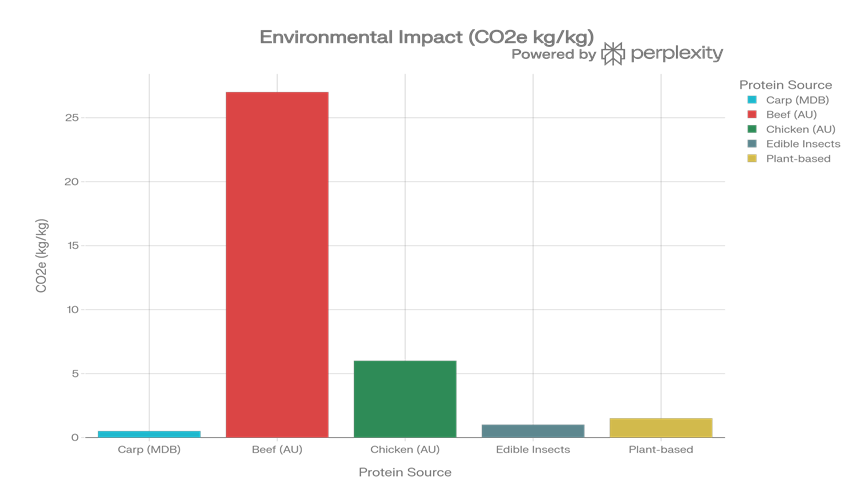
Environmental Impact: Demonstrates the significant sustainability advantage of carp over traditional livestock.
Carp is not just "trash fish." It is a low-carbon, low-cost protein powerhouse. Every tonne we harvest is a tonne of invasive biomass removed from the Murray-Darling, potentially offsetting the environmental cost of traditional livestock.
The "Other" Issues
It isn't just about nutrition. We need to consider:
1. Ecosystem Health: Harvesting provides immediate biomass reduction that biocontrol can only promise for the future
2. Circular Economy: Harvesting carp transforms a biosecurity threat into a circular food asset.
3. Jobs and industry opportunities in regional and rural areas which is positive during these depressing times where cost of living is biting hard.
4. Whether the best alternative for the fish is for humans, animals or the earth that will be determined by those that invest. Logically there are options for all aspects and no doubt more because as soon as the mindset changes from ‘kill and clean up’ to ‘maximise our opportunity’ we will never know what the best outcome will be. Whatever it is will be far superior to the current plan.
5. We have a hole in supply of seafood – we rely on imports, there is very little discussion about this, yet it is essential nutrition and food security.
By not formalising carp as a protein product, we are missing opportunities.
Time to Pivot
We are not saying skip research, but why is our national strategy 100% focused on extermination and 0% on resource recovery? It is time for a National Harvest Strategy that puts carp on the plate rather than just under the microscope. Why have we not spent any time or effort in the ‘extraction of protein’ research.
The Seafood Consumers Association (SCA) calls for a policy shift: Let's invest in a harvest-to-protein roadmap that creates jobs, restores our rivers, and gives Australia a sustainable protein it needs.
Comments
No comments yet.