

What the New Global Tuna Atlas Means for Australian Seafood Consumers
When you buy a can of tuna from the supermarket shelf or order a beautiful piece of Southern Bluefin Tuna at a restaurant, do you ever stop to wonder exactly where that fish swam?
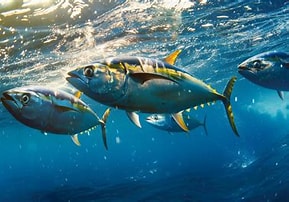
Tuna are the ultimate ocean wanderers. They do not respect national boundaries, crossing entire oceans throughout their long migratory lives. This makes managing them—and preventing seafood fraud—one of the toughest jobs in marine science and fisheries governance.
To bring transparency to the open ocean, the UN Food and Agriculture Organization (FAO) and its partners have officially integrated a groundbreaking digital tool: the ‘FIRMS Global Tuna Atlas (GTA)’.
For the Seafood Consumers Association (SCA), this tool represents a massive win for data literacy and consumer transparency. Here is what the Atlas does and what it reveals about the tuna on Australian plates.
What is the Global Tuna Atlas?
Historically, data on global tuna was scattered across five different Tuna Regional Fisheries Management Organizations (t-RFMOs)—the international bodies responsible for overseeing different patches of the world’s oceans. Because, typically, each organization used different formats, units, and data structures, comparing what was happening across different ocean basins was incredibly difficult. The Global Tuna Atlas solves this by harmonizing data from all five t-RFMOs into a single, high-resolution public mapping platform. It provides an unprecedented look at historical tuna and related fisheries catches, spanning up to 100 years of data in certain areas and mapping roughly 50 core market species.
Fascinating Facts for Australian Seafood Consumers
1. The Pacific Ocean is the Global Epicentre - If you look at the Atlas's interactive map viewer, you’ll quickly notice that the Western and Central Pacific Ocean (WCPO)—right on Australia’s doorstep—dominates global catch charts. This region supplies over half of the world's commercial tuna. When you buy canned skipjack or yellowfin tuna in Australia, there is a very high probability it was caught in these rich Pacific waters. Sadly, though very little by Australian businesses.
2. Tracking the Transition in Fishing Methods - The Atlas allows users to filter decades of data by "fishing gear". This highlights a massive historical shift: In the mid-20th century, a significant portion of tuna was caught using traditional ‘pole-and-line’ methods. By the late 20th and early 21st centuries, industrial ‘purse seine’ fleets (using massive nets) and pelagic ‘longlines’ became the dominant methods for meeting soaring global consumer demand. Understanding these gear changes helps scientists evaluate bycatch risks, particularly for open-ocean species like pelagic sharks.
3. Australia's Crucial Role in Protecting Southern Bluefin - Australia is a key member of the Commission for the Conservation of Southern Bluefin Tuna (CCSBT), one of the five t-RFMOs feeding data into this global system. Southern Bluefin Tuna is a premium, slow-growing species that faces heavy management scrutiny. The Atlas tracks how strict global quota systems have successfully been utilized over the years to step back from historical overfishing and steer these precious apex predators toward stock rebuilding.
The SCA Perspective - Transparency Defeats Deception
At SCA, we frequently emphasize that food fraud hides in a vacuum of information. When supply chains are murky, it is easy for low-value, poorly managed fish to be mislabeled as premium, sustainably caught tuna. The FIRMS Global Tuna Atlas is an important weapon against this opacity. By making standardized, spatialized catch data publicly accessible, it bridges the gap between scientific management and public understanding. It proves that the seafood industry can standardize its data globally when there is a collective will to ensure sustainability.
How to use your consumer power
The next time you purchase premium tuna, look for clear catch zone reporting on the packaging. Thanks to open-access platforms like the Global Tuna Atlas, the "open ocean" is no longer an unmapped black box. Want to see where the fish roam? Explore the authoritative historical trends yourself using the FIRMS Global Tuna Atlas Interactive Map Viewer.
Update: Why Map Data Can’t Outrun the Fuel Shock
While tools like the Global Tuna Atlas give us an unparalleled look at the spatial history of tuna fishing, expert fisheries adviser Francisco Blaha reminds us of a hard truth: In tuna fisheries, fuel prices underlie it all.
Right now, a major maritime crisis across the Persian Gulf, the Strait of Hormuz, and the Red Sea has sent shockwaves directly into the Pacific. Consider these staggering realities unfolding behind the scenes:
The Invoice of War: Fuel accounts for a massive 40% to 65% of a tuna vessel’s operating costs. When Middle Eastern conflicts erupt, Pacific tuna fleets don't just see headlines—they get a massive fuel invoice.
The Singapore Connection: The Pacific tuna fleet relies heavily on bunker fuel from Singapore, which imports its crude through the volatile Strait of Hormuz. Consequently, Singapore bunker fuel prices sky-rocketed from USD $709 per tonne to $1,630 per tonne in a matter of six weeks. Fuel costs literally doubled.
The Price Asymmetry: While skipjack tuna prices rose from $1,600 to $2,000 per tonne, it wasn't nearly enough to offset the doubling of fuel costs. Vessel operators are facing extreme margin compression.
What This Means at the Supermarket Checkout
Unlike other retail goods, industrial fishing operations can’t simply pass on fuel spikes overnight. Instead, the system adapts operationally: fleets make fewer trips, delay departures, and slow down their logistical networks. When fuel economics distort this deeply, the ripple effects hit consumers hard through exploding air-freight costs for fresh fish and tightened cold-chain logistics.
The SCA Bottom Line: The maps in the Global Tuna Atlas show us the potential of our oceans, but global geopolitics and skyrocketing fuel walls are what dictate the reality of what lands on your plate. True seafood literacy means understanding that the price of your tuna is tied as much to global energy security as it is to fish stocks.
#FisheriesEconomics #FuelCrisis2026 #SupplyChainReality #TunaFisheries #SCAInsights #SCA #SeafoodTransparency #GlobalTunaAtlas #SustainableFishing #OceanLiteracy #ConsumerRights #FAO
References:
Francisco Blaha’s report, “In tuna fisheries... fuel prices underlie it all,”
Explore the Atlas interactive map - viewer https://lnkd.in/e9UykwyT and more on the Atlas https://lnkd.in/eaZiVmXg

Comments
No comments yet.