Key Takeaways from the 2026 FAO GLOBEFISH Global Seafood Fraud Webinar
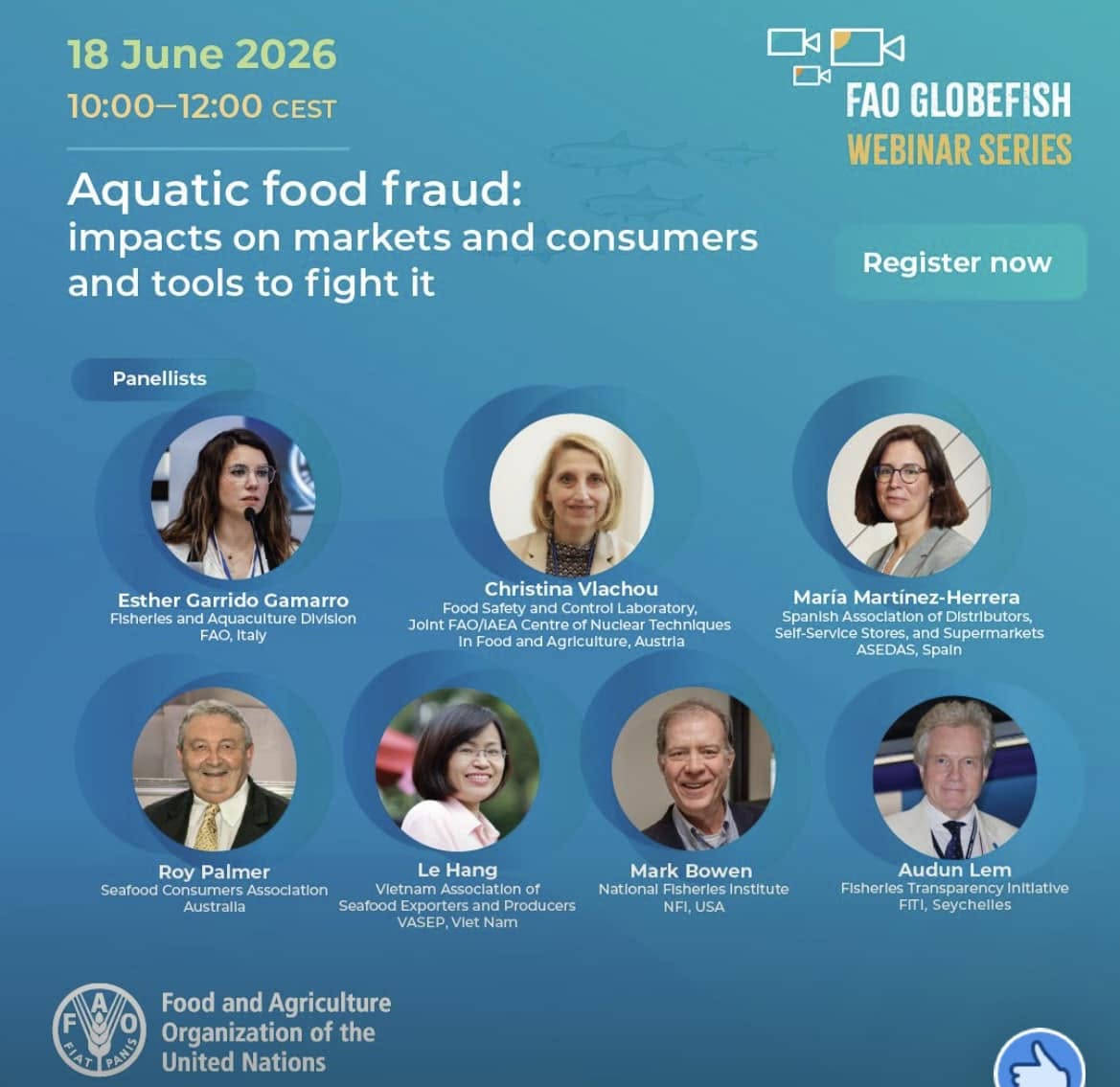
On June 18, 2026, the Food and Agriculture Organization of the United Nations (FAO) hosted the first virtual session of its highly anticipated 2026 GLOBEFISH Webinar Series: "Aquatic Food Fraud: Impacts on Markets and Consumers and Tools to Fight it." Bringing together an international panel of regulatory bodies, researchers, and trade leaders, the webinar examined how market demand, steep price incentives, and fragmented supply chains actively create conditions for widespread consumer deception.
For the Seafood Consumers Association (SCA), being invited to present on this prestigious panel alongside global fisheries experts represents a powerful confirmation that the consumer’s voice is finally being recognized as central to the international food safety dialogue.
Here is an analytical report on the key insights, the scale of the crisis, and the tools discussed to safeguard the integrity of our shared public food bowls.
The Real Cost of Deception: 20% of Global Trade Impacted
The global fisheries and aquaculture sector is currently valued at a staggering $195 billion, yet it remains uniquely vulnerable to illicit manipulation. While precise data is difficult to isolate due to the clandestine nature of food crime, empirical studies highlighted during the session suggest that up to 20 percent of the international seafood trade is subject to some form of fraud. This rate is noticeably higher than corresponding statistics for the meat or produce sectors.
As defined by the panel, aquatic food fraud is "a deliberate practice intended to deceive others." It thrives on a vast diversity of species, complex processing methods, and structural governance gaps. The core deceptive practices discussed include:
- Species Substitution & Mislabeling: Sneaking cheaper, lower-grade, or illegally caught fish into high-value supply lines (such as passing off imported Basa as premium domestic fillets).
- Geographic Origin Forgery: Illegally hijacking iconic regional provenance tags to drive up profit margins. The CoOL legislation will not solve domestic issues such as there being more ‘Coffin Bay’ Pacific Oysters sold than harvested as an example.
- Quality & Sustainability Fraud: Making false or unverified claims about harvesting methods, traceability, and environmental metrics.
The panel emphasized that this goes far beyond basic economic theft; it is an overt threat to global biodiversity, fair market competition, and public health—regularly masking allergens, biosecurity hazards, and environmental contaminants.
Insights from the Frontlines: A Fractured Ecosystem
The session benefited from an extraordinary breadth of geographic and institutional perspectives, mapping out the problem across different stages of the global supply chain:
- The Regulatory and Market Lens (US & Europe): Representatives like Mark Bowen (National Fisheries Institute, USA) and María Martínez-Herrera (ASEDAS, Spain) outlined how price incentives and supply chain vulnerabilities dictate retail behavior. When inflation squeezing occurs, the pressure to maintain low price points at supermarkets and restaurants can inadvertently incentivize procurement blind spots, allowing fraudulent products to slip onto shelves.
- The Production Sector Perspective: Le Hang, Deputy General Secretary of the Vietnam Association of Seafood Producers (VASEP), provided crucial insights into how major exporting nations are scrambling to implement stringent internal quality controls to protect their international trade reputations and maintain compliance with strict foreign entry requirements.
- The Transparency Shield: Audun Lem, Chair of the Fisheries Transparency Initiative (FiTI), reinforced that public data accessibility and structural transparency are the primary defence mechanisms against illicit trade. When governments fail to publish registry data, licensing details, and catch metrics, it creates the dark conditions where food fraud and illegal fishing flourish.
The Technology Shield: Nuclear and Forensic Breakthroughs
One of the most encouraging segments of the webinar focused on the evolution of rapid, unassailable scientific tools designed to catch fraudsters on the spot.
Christina Vlachou, Laboratory Head of the Food Safety and Control Laboratory at the Joint FAO/IAEA Centre of Nuclear Techniques, presented the extraordinary progress being made in Stable Isotope and Trace Element Analysis. This science moves past standard DNA profiling—which can identify a species but cannot tell you where it lived—and instead reads the unique geographic fingerprint left behind by local water and soil chemistry.
Transitioning these sophisticated nuclear methodologies into handheld, cost-efficient devices for local food safety inspectors and supply-chain auditors is the next major frontier in protecting market authenticity. ANSTO in NSW is part of this activity and they had a Seafood Provenance Workshop on 2 June to update their progress.
The SCA Stance: Stepping from the Lab onto the Shop Floor
Representing everyday consumers on the panel, SCA CEO, Roy Palmer underscored that the ultimate victim of these governance failures is the family dinner plate.
While elite international tracking technology and forensic testing are fantastic milestones, they are symptoms of a reactive strategy. True target-hardening of our food systems requires matching this elite science with rigorous, top-down regulatory frameworks. Additionally, Palmer highlighted the frustration of authorities working in silo’s focusing on just one aspect of fraud when there are many.
Regulatory Asymmetry and Border Control Failure
Palmer highlighted the stark contrast in how seafood weight integrity is policed reveals a deep, unacceptable failure in consumer protection at the Australian border.
Honest information regarding packaging net weights is a fundamental consumer right, yet the Australian Government continues to minimize short weighting as an ordinary, private commercial "quality issue" to be settled between buyers and sellers.
This hands-off approach directly leaves the market (read consumers…) open to blatant economic deception—where everyday families pay premium seafood prices for frozen tap water.
While the US FDA treats short-weighted frozen seafood strictly as Economically Motivated Adulteration (EMA) and enforces immediate border detentions, and the EU utilizes its Rapid Alert System (RASFF) to block and reject entries for undeclared water addition, Australia conducts zero border checks for weight fraud. SCA have raised this issue with the Productivity Commission but is yet to have any formal response or be aware of any proposed changes.
By maintaining strict, audited verification standards for our exporters to protect "Brand Australia" abroad while operating a toothless, complaint-driven "honour system" for domestic sales and imports, our regulatory framework has effectively turned Australia into a soft target and a global dumping ground for fraudulent stock rejected by more stringent international jurisdictions.
On the Educational Deficit at the Frontline Counter
SCA are supporters of training and education yet believe the Australian seafood industry have lost their way in this regard.
Palmer highlighted this systemic vulnerability is severely aggravated by a critical lack of formal education and training at the "window" of the industry—the retail counters and hospitality venues where seafood is directly sold to the public. The Australian seafood retail sector operates in a virtually low-to-nil entry-level framework, where frontline staff are regularly placed face-to-face with consumers without any structural training in product integrity, species identification, or consumer law.
While concrete national data tracking the precise percentage of certified or formally trained fishmongers remains completely absent, broader industry assessments reveal a major workforce capability gap.
Frontline operators frequently purchase frozen products "by the bag or box" from distributors, remaining entirely unaware that they are accepting 15% to 20% weight deficits caused by excessive glazing or chemical soaking. Because counter staff lack micro-credentials in standard verification practices—such as the National Measurement Institute’s official "Frozen Fish" partial-thaw method or the Australian Fish Names Standard (AS 5300)—they lack the tools to spot fraud, inadvertently passing the economic penalty and misinformation straight down to the unsuspecting consumer.
For consumers, the path forward relies on government action on weights/measures plus these four fundamental structural pillars:
- Mandatory Truth-in-Labeling Standards: Universal national adoption and strict enforcement of transparent metrics like the Australian Fish Names Standard (AS 5300) – still voluntary despite FAO highlighting the imperative of food safety issues that knowing the correct species is essential. Also, the Seafood Industry Australia Pledge outlines how the industry wants to be perceived by the public, while in the USA, the NFI BSB Pledge mandates how the industry must behave in the marketplace. For a pledge to have actual value for everyday consumers, it cannot rely entirely on goodwill. It must transition away from abstract social commitments and adopt the precise, enforceable metrics of the BSB model—treating weight integrity, correct species labeling (AS 5300), and fair-trade practices as non-negotiable statutory requirements.
- Point-of-Sale Transparency: Forcing clear, accessible origin disclosure, which is particularly relevant in Australia as the industry prepares for the upcoming 1 July 2026 Country of Origin Labelling (CoOL) extensions into the hospitality sector. How this will be policed state/territory by state/territory will be interesting.
- Vocational Capability: Training future chefs, culinary students, and procurement managers through proactive educational frameworks—such as SCA's soon to be launched university I-CADMUS micro-credential—to spot illegal fraud like substitution, understand cold-chain compliance, and protect the public interest before the seafood ever reaches the kitchen. An area SCA’s new arrangements with VIITE will play a big role.
- Eradicating the Eco-Labeling Trap (The Sustainability Double-Dip): A critical point of contention is the uncontrolled proliferation of expensive, third-party corporate sustainability labels, which has created a punitive "double-dipping" financial scenario for Australian consumers. Under Australia’s strict, world-class Environment Protection and Biodiversity Conservation (EPBC) Act 1999, Australian wild-caught fisheries are already legally mandated to operate under some of the most rigorous ecological sustainability standards on earth. Despite this comprehensive domestic legal protection, commercial supply chains are continually pressured to pay for overlapping, outside corporate certifications just to place a badge on a box/bag. This redundant eco-labeling adds massive administrative costs to honest local fishers—costs that are directly passed down to families at the supermarket checkout. We must stop treating corporate certifications as the ‘gold’ standard for public trust. Australia needs to drop these outside, commercial accreditations entirely, proudly stand behind the absolute legislative power of our own EPBC Act, and redirect public and industry resources toward what matters most to consumers: point-of-sale weight integrity, true geographic provenance, and affordable access to local food.
Conclusion: One Seafood Future
The 2026 FAO GLOBEFISH webinar made one reality clear: aquatic food fraud is a global crisis that cannot be solved by any nation or industry sector operating in isolation. Only by actively combining rigorous forensic science, systemic regulatory transparency, and targeted workforce education can we restore integrity to the market and ensure that seafood consumers are getting exactly what they pay for.
What are your thoughts? Are you confident that the fish on your plate is exactly what is written on the menu? Let us know in the comments below and engage with the Seafood Consumers Association today to help us fight for real, systemic transparency across our seafood markets.
“26 million Voices. One Seafood Future.”
Comments
No comments yet.