EXECUTIVE SUMMARY
- Australia has demonstrated that it can mobilise substantial national resources when a risk is considered important, with more than $270 million committed to H5 bird-flu preparedness and response.
- Food allergy already affects millions of Australians, yet the Commonwealth's recently announced dedicated funding for the National Allergy Centre of Excellence and National Allergy Council is $14.6 million over two years.
- The Seafood Consumers Association (SCA) is not arguing for less investment in bird-flu preparedness. It is asking what Australia's strong preventative biosecurity response can teach us about protecting consumers from risks already present in the food system.
- Australia's seafood consumer-protection system remains fragmented across food safety, imports, trade measurement, consumer law, fisheries, fish naming and state and territory enforcement.
- Australia requires recognised fish names in important seafood export documentation, yet the Australian Fish Names Standard AS 5300 remains voluntary for seafood sold domestically, including imports. SCA asks why Australian consumers receive a lower level of naming consistency than Australia's export system.
- Imported packaged seafood must comply with Australian weights and measures requirements, but trade-measurement enforcement and imported-food inspection operate through different regulatory systems. SCA believes there is a case for examining stronger risk-based verification of net weight and excessive glazing in imported frozen seafood.
- Australia's new Plain English Allergen Labelling requirements are a significant improvement, including separate declarations for fish, crustacean and mollusc, but legislation must be backed by education, surveillance, enforcement and accurate seafood identification.
- SCA is calling for better coordination rather than simply another regulator—connecting seafood identity, country of origin, allergens, traceability, weights and measures, food-safety surveillance, fraud intelligence and consumer complaints.
- Consumers experience all these regulatory issues at the same dinner table. They should be able to expect that the seafood is what the seller says it is, comes from where claimed, contains the quantity stated, declares relevant allergens and is safe to eat.
Key SCA message
“When governments decide a risk matters, they build systems around it. The question we should be asking is whether Australia has built sufficiently strong and connected systems around the food risks and economic harms confronting consumers every day.”
-----------------------------------------------------------------------------------------------------------------------
Australia can mobilise hundreds of millions of dollars to prepare for an emerging animal-disease threat. What might that teach us about the everyday risks already confronting food consumers?
Australia is preparing seriously for H5 bird flu.
And it should.
In August 2026, the Albanese Government announced further funding that brought its total investment in H5 bird-flu preparedness and response to more than $270 million.
The money supports surveillance and early detection, emergency response capability, wildlife protection, community engagement and other preparedness measures.
That is sensible risk management.
A serious threat is identified > Government assesses the potential consequences > Resources are mobilised > Surveillance is established > Responsibilities are allocated > Prevention begins before catastrophe arrives.
But it raises an interesting question for the Seafood Consumers Association.
What can that approach teach us about risks consumers are already living with every day?
Consider food allergy
In April 2026, the Australian Government announced a further $14.6 million over two years for the National Allergy Council and National Allergy Centre of Excellence.
That investment is welcome. Australia has a significant allergy problem.
The Government itself says allergic disease affects approximately one-third of the Australian population, while one in ten babies is diagnosed with food allergy.
Australia has also introduced improved Plain English Allergen Labelling requirements.
Since February 2024, prescribed allergens have had to be declared using required plain-English terminology, and the transition period for older labels ended on 25 February 2026.
Importantly for seafood consumers, the system now distinguishes:
FISH
CRUSTACEAN
MOLLUSC
These are important improvements.
But look at the contrast.
More than $270 million committed to H5 bird-flu preparedness.
A further $14.6 million specifically announced for national allergy research, care and support.
These figures are not directly comparable.
Bird-flu expenditure protects agriculture, wildlife, biodiversity, trade and potentially human health, while Australians with allergies also receive assistance through hospitals, Medicare, medicines, research and other health expenditure not captured in the $14.6 million figure.
So, this is not an argument that Australia is “spending money on birds instead of people”.
That would be simplistic. The better question is:
If prevention, surveillance, coordination and national investment make sense for an emerging biosecurity threat, shouldn't we apply the same philosophy wherever significant consumer risks can be prevented?
And food allergy is only one example
Once we ask that question, some interesting inconsistencies emerge.
Take seafood names.
Australia has invested considerable time, expertise and public resources developing the Australian Fish Names Standard — AS 5300.
The objective is simple and sensible > One fish > One Standard Fish Name > Less confusion > Better traceability > Greater consumer confidence.
Yet there is a curious feature of the Australian system.
The Australian Fish Names Standard is mandatory for exports—but voluntary for seafood sold to Australians!
Australian seafood being exported must comply with export requirements concerning Australian Fish Names and/or scientific names.
DAFF's export systems incorporate those names into export documentation.
But FRDC describes AS 5300 as voluntary throughout Australia's domestic seafood supply chain—including for imported seafood.
Think about that from a consumer perspective.
Australia insists upon standardised fish identification when seafood leaves Australia.
But when seafood is sold to an Australian consumer—whether locally produced or imported—the national Fish Names Standard itself remains voluntary.
Why?
Chinook or King illustrates the problem
We saw a perfect example recently.
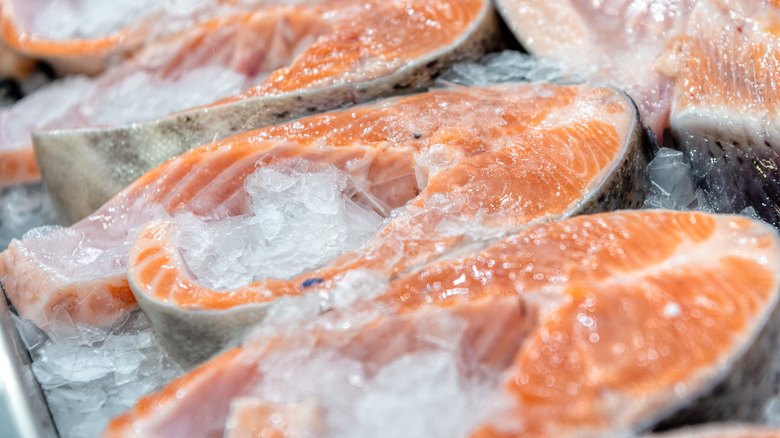
The Victorian Fisheries Authority stocked Chinook Salmon into Lake Purrumbete. The species is Oncorhynchus tshawytscha. The Australian Standard Fish Name is Chinook Salmon. Yet the same species farmed in New Zealand is widely marketed to Australian consumers as King Salmon.
King Salmon is a legitimate New Zealand name. SCA is not suggesting otherwise.
Our question is much simpler.
If Australia has established a national naming standard, why isn't it consistently applied to seafood marketed in Australia?
If industry believes another name is better, there is an established process to apply to amend the Standard.
Either use the Standard—or use the process to change it.
Otherwise, what is the point of having a national standard?
Now consider weight
Another fundamental consumer expectation is even simpler.
If a seafood package says: NET WEIGHT 1 kg ….the consumer should receive one kilogram of seafood, not packaging, excess ice or some other material included in the declared product weight.
Australian trade-measurement law already requires manufacturers, packers, importers and sellers of prepacked goods to ensure quantity markings are accurate.
That is important.
And Australia's National Measurement Institute conducts substantial compliance activity.
In 2024–25, NMI inspectors examined 55,615 lines of prepacked goods representing 213,773 individual packages.
Around 3% of product lines tested contained less product than declared.
That is not insignificant.
But it raises another seafood-specific question.
Where should imported seafood net weight be verified?
Australia operates an Imported Food Inspection Scheme at the border. Its principal focus is ensuring imported food meets Australian food-safety requirements, the Food Standards Code and country-of-origin labelling requirements.
Trade measurement is administered separately.
So SCA believes there is a legitimate question worth investigating:
Should net-weight compliance for higher-risk imported prepacked seafood be more deliberately integrated into border or post-border surveillance?
This is particularly relevant to frozen seafood. Water and glazing are routinely and legitimately used to protect frozen seafood.
The problem arises when end users/consumers pay seafood prices for water that should not form part of the declared net quantity.
The law already requires accurate measurement.
The issue is ensuring there is sufficient verification and enforcement.
Australia already accepts risk-based border inspection
This is not a radical proposition.
Australia already operates imported-food controls according to risk. Food classified as risk food initially faces inspection at 100% of consignments, with rates falling after a history of compliance.
Most food classified as surveillance food is referred randomly, generally at a rate of 5%.
Some Ready-to-Eat finfish is itself classified as risk food. So, the principle is already established:
higher risk = greater scrutiny.
Perhaps we need to consider that principle more broadly when consumer economic integrity is at stake as well as immediate food safety.
Food safety and economic integrity are not always separate
This becomes particularly important with seafood.
Wrong species?
That may appear to be an economic issue but what if the substituted species carries a different toxin, allergen or handling risk? Incorrect origin?
That may appear to be a labelling issue, but origin can be fundamental to traceability during a food-safety incident.
Incorrect weight? That may appear to be purely economic but systematic short-weighting is still taking money from consumers for product they did not receive.
Undeclared allergen?
Now the consequence can become life-threatening.
These regulatory categories may sit in different government departments.
The consumer experiences them all at the same dinner table.
Perhaps the real problem is fragmentation
Australia does not lack regulators.
FSANZ develops food standards.
DAFF manages imported-food and biosecurity controls.
NMI administers trade measurement.
The ACCC administers important consumer-law provisions.
States and territories enforce substantial parts of Australia's food laws.
Fisheries agencies regulate fisheries.
FRDC supports/invests in the Australian Fish Names Standard AS 5300.
Each has legitimate responsibilities.
But consumers don't organise their lives according to government portfolios.
They simply expect:
The fish is what you say it is.
The origin is what you say it is.
The weight is what you say it is.
The ingredients are what you say they are.
The allergens are clearly disclosed.
And the food is safe.
That is not an unreasonable expectation.
What bird-flu preparedness teaches us
The lesson from Australia's H5 preparedness is not that government should spend less on bird flu. Quite the opposite.
It demonstrates what can happen when government identifies a potentially serious risk and responds nationally.
There is surveillance > There is science > There is funding > There is coordination > There are reporting systems > TV advertisements promoting informative websites > There are clearly allocated responsibilities.
And there is an emphasis on prevention rather than waiting for the damage and then reacting.
Those principles should sound very familiar to anyone interested in food integrity.
Imagine applying the same philosophy to seafood consumers
Imagine a system where Australia could progressively connect:
accurate fish identification;
allergen information;
country of origin;
traceability;
net-weight verification;
food-safety surveillance;
seafood illness reporting;
fraud intelligence; and
consumer complaints.
Not necessarily another regulator. Not another expensive bureaucracy. Better coordination of what Australia already has. Patterns could become visible.
A species substitution detected in one jurisdiction could inform surveillance elsewhere.
Repeated short-weight failures involving an imported product could trigger increased scrutiny.
An undeclared allergen could connect immediately with traceability records.
Consumer illness reports could identify emerging species, location or supply-chain risks.
And seafood fraud intelligence could inform food-safety surveillance.
That is increasingly the philosophy behind SCA's work and the development of I-CADMUS.
One consumer, one food, many regulators
Governments inevitably divide responsibilities. Consumers don't.
A seafood meal can simultaneously involve questions of:
health, measurement, identity, origin, sustainability, fraud, food safety and value for money.
We should therefore stop viewing those issues entirely through separate regulatory windows.
Australia's bird-flu investment demonstrates the value of preparing for risk before it becomes crisis.
Perhaps there is a broader lesson.
We should ask not only:
How much does government spend after a problem becomes serious?
But:
What would it cost to prevent the problem in the first place?
For food allergy, that means research, education, accurate declarations and excellent allergen management. Communication throughout he supply chain.
For seafood names, it means consistent identification.
For imports, it means intelligent risk-based verification.
For weights and measures, it means ensuring consumers receive what they pay for.
For seafood fraud, it means connecting intelligence before fraudulent product reaches the plate.
None of these requires us to choose between bird flu and food consumers.
Australia can and should do both.
The real lesson is simpler:
When governments decide something matters, they build systems around it.
For SCA, the question is:
Are we building sufficiently strong systems around the things that matter every day to Australian food consumers?
That is a conversation worth having.
ENDS
MEDIA CONTACT
Roy D. Palmer, MBA
CEO, Seafood Consumers Association Ltd
Email: seafoodsdg@outlook.com Phone: +61 492825012
Seafood Consumers Association Ltd
Putting consumers at the centre of seafood policy.
“26 Million Voices. One Seafood Future.”
Comments
No comments yet.